Ultra‑Thin Flexible Anti‑Metal Tags: Why They Matter for Industrial RFID
Time: 2026-07-14 08:55:23Source: Laxcen
In industrial manufacturing, data centers, energy infrastructure, and even daily warehouse management, metal assets always occupy a core position—machine tools, cabinets, pipes, metal tooling fixtures… These assets are high-value and frequently used, making digital tracking an inevitable choice for enterprises to reduce costs and increase efficiency. However, when companies attempt to use RFID technology to attach “digital ID cards” to these metal assets, a deep-rooted physical problem emerges: metal severely interferes with radio frequency signals, making ordinary tags almost ineffective on metal surfaces.
To solve this problem, anti-metal tags were developed. However, traditional anti-metal tags are mostly made of rigid materials (such as PCBs and ceramics), only suitable for flat metal surfaces, and ineffective on curved surfaces such as pipe arcs and tool handles. Therefore, flexible anti-metal tags were developed, partially solving the problem of application on curved surfaces with the help of bendable substrates and built-in absorbing layers. However, practical applications quickly revealed a new shortcoming—thickness.
Commercially available flexible anti-metal tags typically range in thickness from 1 mm to 1.2 mm. This 0.2 mm difference may seem insignificant, but in data center cabinets densely packed with precision equipment, or on the surfaces of medical instruments requiring frequent cleaning, raised tags not only hinder operation but are also prone to peeling off due to impacts. More importantly, thicker tags inevitably create a larger "suspended area" between the tag and the metal surface. In environments with long-term vibration or temperature variations, uneven stress on the adhesive layer increases the risk of detachment.
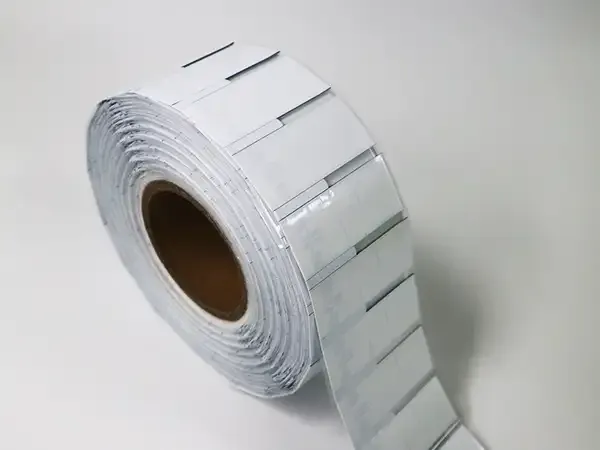
It is against this backdrop that ultra-thin flexible anti-metal tags have become a rigid requirement for an increasing number of asset managers. Taking our M6025MF ultra-thin flexible anti-metal tag as an example, it compresses the overall thickness to 0.5 mm—less than half the thickness of traditional products. This thickness results in a truly "unobtrusive" fit: the tag adds almost no external dimension to the asset, and even when applied to narrow gaps in guide rails or curved pipe walls, it adheres tightly like a protective film, neither affecting equipment operation nor easily shifting due to external scrapes.
Of course, thinness alone is not enough. The core of anti-metal performance lies in the effectiveness of the absorbing isolation layer in counteracting metal reflections. The M6025MF maintains excellent anti-metal performance despite its ultra-thin design. After application, the read/write distance remains stable with minimal signal fluctuations. Even during rapid reader movement in bulk inventory checks, it maintains a high success rate. This means warehouse personnel no longer need to scan each item individually or repeatedly adjust angles, resulting in a substantial improvement in the speed and accuracy of asset inventory checks.

From an application perspective, ultra-thin flexible anti-metal tags fill the gap between rigid tags and traditional flexible tags. They are particularly suitable for scenarios such as: curved sections of oil pipelines—the tags can be bent and adhered, and their thickness does not hinder the installation of insulation layers; front and rear panels of IT servers—the ultra-thin design does not occupy narrow U-shaped space; and wrenches and pliers in metal toolboxes—even when stacked, stable anti-metal properties ensure accurate recording of each loan and return.
In conclusion, the development of ultra-thin flexible anti-metal tags is not a technological "show," but a natural product of real-world business needs. When companies require RFID tags to work stably on metal surfaces, conform to irregularly shaped surfaces, and be as thin and invisible as possible, 0.5 mm flexible anti-metal tags become the optimal solution.