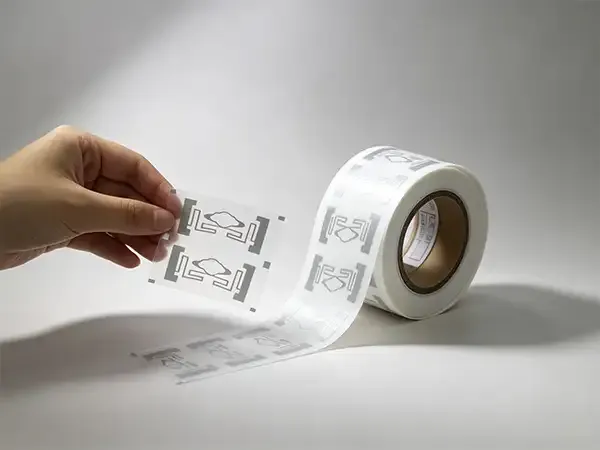
What is the Difference Between Dry Inlay and Wet Inlay?
Time: 2026-07-10 09:40:31Source: Laxcen
In the manufacturing and application of RFID (Radio Frequency Identification) electronic tags, Inlay is a core concept. It refers to a semi‑finished component that integrates a radio frequency chip and an antenna on a flexible substrate (such as PET or paper). It is the critical intermediate product before an RFID tag is finally encapsulated. Depending on whether it comes with self‑adhesive, Inlays are generally divided into Dry Inlay and Wet Inlay. Although they differ only by the presence of adhesive, there are significant distinctions in structure, usage, cost, and applicable scenarios.
1. Structural and Compositional Differences
From a physical structure perspective, the Dry Inlay is relatively simple. It consists only of the antenna layer, the chip, and the protective encapsulation layer for the chip. Its surface has no adhesive, and there is no release liner (backing paper) on the reverse side. It is usually supplied in roll or sheet form, leaving ample room for subsequent secondary processing.
The Wet Inlay, on the other hand, adds several additional layers on top of the Dry Inlay. Its complete structure is: antenna + chip + pressure‑sensitive adhesive layer + release liner. Some products may also have a protective top film (face sheet) over the front. In essence, the Wet Inlay is a semi‑finished tag that already has pre‑applied adhesive and a peel‑off release liner, allowing end‑users to use it directly.
2. Differences in Usage and Processing Methods
Because of the presence or absence of adhesive, the subsequent handling processes for the two types differ greatly.
The Dry Inlay has no adhesive, so it cannot be directly attached to an object’s surface. It must undergo a secondary lamination or converting process – that is, through dedicated bonding or laminating equipment, the Dry Inlay is embedded into the user‑designed outer materials (such as paper label face stock, plastic card substrates, fabrics, or industrial tapes). Then, hot‑melt adhesive or transfer adhesive may be applied as needed to form a complete finished tag. This processing is relatively complex, requiring higher precision and process control, but it offers users a great deal of freedom in material selection.
The Wet Inlay, having already been pre‑combined with an adhesive layer and release liner, eliminates the steps of applying adhesive and adding liner. Users simply peel off the release liner and directly affix the chip‑and‑antenna structure onto any flat surface. Its usage is essentially the same as common adhesive stickers, greatly simplifying the final application process.
3. Cost and Packaging Density Considerations
From a direct manufacturing cost perspective, Dry Inlays are typically cheaper per unit than Wet Inlays of the same model because they omit the adhesive layer and release liner. Moreover, since Dry Inlays do not have a liner, a roll of the same diameter can accommodate significantly more Dry Inlays than Wet Inlays, offering advantages in shipping and storage space.
Wet Inlays, which include adhesive and liner, have higher material and processing costs, resulting in a higher unit price. Additionally, the liner adds thickness, so the number of tags per unit volume in a roll is lower. However, for the end‑user, Wet Inlays save the cost of purchasing separate adhesives or additional converting steps, so for small‑scale or rapid‑deployment projects, the total cost may not necessarily be higher.
4. Durability and Environmental Suitability
Because Dry Inlays are typically embedded inside other materials (such as plastic sheets, fabric layers, or thick cardboard), the chip and antenna are protected by the outer layer. Consequently, the finished tags generally exhibit strong resistance to mechanical abrasion, high temperatures, and chemical corrosion, making them suitable for long‑term use or repeated contact scenarios.
Wet Inlays, however, are directly applied to the surface of an item, with the adhesive and face material exposed to the external environment. Under high temperature, humidity, frequent friction, or strong UV radiation, the adhesive may age and fail, and the face material may be damaged, leading to tag failure. Therefore, Wet Inlays are more suitable for indoor, ambient‑temperature applications with shorter life cycles or where tags are frequently replaced.
5. Typical Application Scenarios
Based on the above characteristics, Dry Inlays are commonly used in situations where the RFID function needs to be embedded within the product itself. Examples include: internal lamination in smart cards (contactless IC cards), permanent library book tags, clothing care labels or woven labels, embedded tags for medical equipment or medical record folders, and tracking of industrial products that undergo high‑temperature and high‑pressure processes.
Wet Inlays are widely used in scenarios that require fast and simple attachment of tags to item surfaces. Examples include: instant retail price labels, courier and logistics tracking labels, warehouse shelf bin labels, temporary badges for exhibitions or events, and temporary labeling of medical instruments or drug vials in healthcare settings.
In summary, Dry Inlays and Wet Inlays are not about which is superior; they are two complementary forms derived from different stages of the RFID industry chain and different application needs.