LF, HF, and UHF RFID: Key Differences in Range, Speed, Interference, and Use Cases
Time: 2026-07-10 09:38:50Source: Laxcen
Low Frequency (LF), High Frequency (HF), and Ultra‑High Frequency (UHF) are the three core RFID frequency bands. They differ significantly in read range, data rate, anti‑interference capability, and application scenarios. NFC (Near Field Communication) is a specific subset of High‑Frequency RFID.
In terms of operating frequency and working principle, LF (125 kHz/134.2 kHz) and HF (13.56 MHz) both use inductive coupling as a near‑field communication method, relying on changes in the coil’s magnetic field for data transmission. UHF (860–960 MHz), on the other hand, uses electromagnetic backscatter as a far‑field communication method, transmitting data by reflecting electromagnetic waves. This fundamental difference determines their distinct performance characteristics.
In terms of read range, the three bands show a stepwise increase: LF has the shortest range, effectively under 0.5 meters; HF typically works within 10 to 50 centimeters and rarely exceeds 1 meter; UHF extends significantly, with passive tags reaching 1 to 10 meters, and active tags can even exceed 100 meters. At the same time, data transmission rate and multi‑tag reading capability also improve markedly with higher frequencies: LF has the lowest rate and can hardly identify multiple tags simultaneously; HF offers a moderate rate with some anti‑collision capability; UHF possesses powerful anti‑collision mechanisms, enabling second‑level batch reading of hundreds of tags, which is at the core of its efficiency.
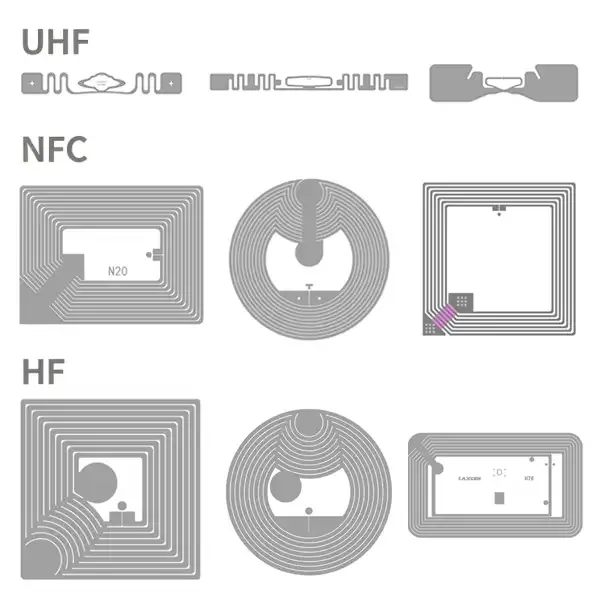
In terms of anti‑interference performance, the bands behave quite differently. LF, with its long wavelength and strong diffraction, is insensitive to water and metal, offering excellent penetration. HF is moderately affected by metallic environments and may require special treatment. UHF is very sensitive to liquids and metals; signals can degrade sharply in such complex environments, so the deployment context must be carefully considered.
Regarding standards and applications, LF mainly follows ISO 11784/11785 and ISO 14223. Leveraging its strong penetration, it is widely used in animal identification (implantable chips), access control cards, and automotive immobilizer keys. HF is primarily based on ISO 14443 (for close‑range payments), ISO 15693 (for longer‑range library applications), and the well‑known NFC standard, giving rise to contactless payments, transit cards, campus cards, e‑passports, and many other everyday applications. UHF adopts ISO 18000‑6C (EPC Gen2) as its core standard. With its long read range and high‑speed batch reading, it has become the preferred technology for modern logistics and supply chain management, large‑scale warehouse inventory, retail clothing tagging, and automated production line tracking.